Română
Between 18 and 20 May 2026, the European DIGIT-ABLE project brought together three connected activities in Iași: a hackathon focused on challenges faced by communities, a panel on digitalisation and skills development in the social economy, and a transnational study visit.
All three formats explored the same question: how can technology increase access, autonomy and the capacity of social organisations without creating new forms of exclusion?
The discussions did not begin with fashionable platforms or digital tools. They began with the difficulties organisations encounter, the experiences of persons with disabilities and the need for solutions that work in everyday practice.
Through DIGIT-ABLE, ADV Romania creates opportunities for social organisations to learn, test ideas and develop solutions alongside technology specialists, entrepreneurs, funders and European partners.
DIGIT-ABLE in Iași, in numbers
The activities organised in May included:
- three days of meetings, cooperation and peer learning;
- 80 applications submitted for the hackathon;
- 16 organisations selected from across Romania;
- nine mentors and one facilitator;
- a European panel on skills and digitalisation;
- a transnational study visit;
18 May: Digitalisation started with challenges from communities
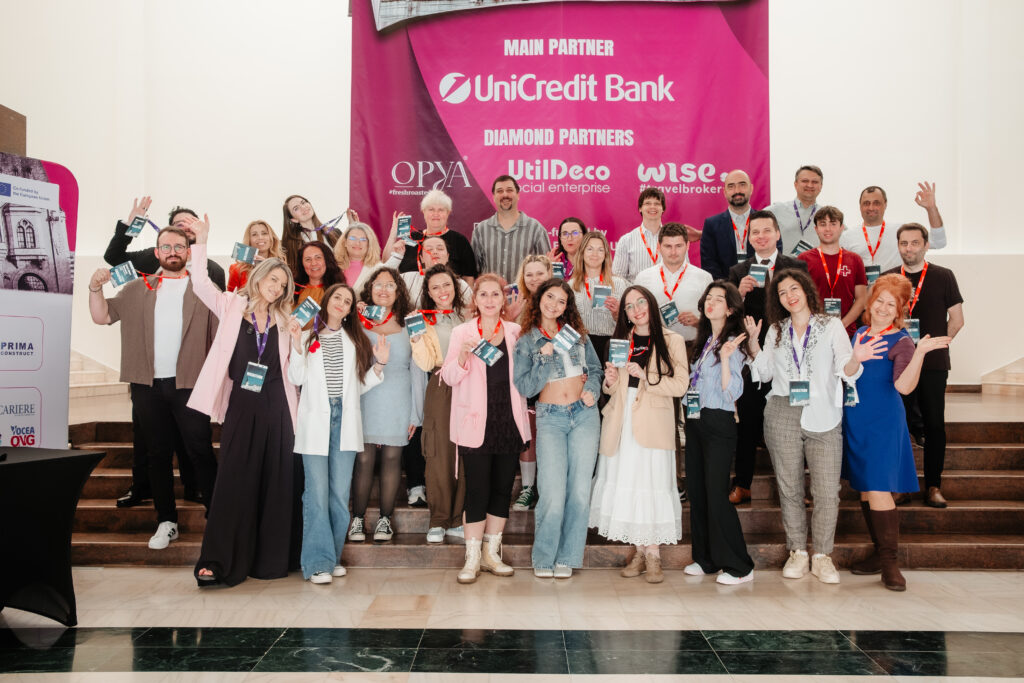
The first activity was the DIGIT-ABLE Hackathon, organised in Iași as part of the project.
Participants brought forward challenges encountered in the work of their organisations and spent one day identifying digital solutions with practical potential.
The format covered several stages: understanding and defining the problem, forming teams, developing the idea, testing assumptions and presenting the proposed solution to the jury.
The process was supported by nine mentors and facilitator Valentin Măzăreanu, a trainer and strategist in digital transformation and security. The teams received expertise in technology, user experience, communication, business development and the assessment of a solution’s social readiness.
During the Social Enterprise Accelerator Gala, Elena Sobieski, DIGIT-ABLE Project Manager at ADV Romania, described how the participants worked:
“Sixteen organisations from across Romania were selected from 80 applications. They came to Iași and spent an entire day trying to find solutions to challenges in their communities. They did not work alone. Nine mentors and a facilitator guided them throughout the process. It was wonderful to see people who were meeting for the first time working as though they had collaborated throughout their lives.”
The hackathon showed that digitalisation becomes easier to understand when the starting point is a clearly defined challenge.
An organisation does not primarily need an application or an artificial intelligence tool. It first needs to understand which process is not working, who is affected and what outcome needs to improve.
Only after this stage can the appropriate technical solution be assessed.
APROAPE, the winning project of the DIGIT-ABLE Hackathon
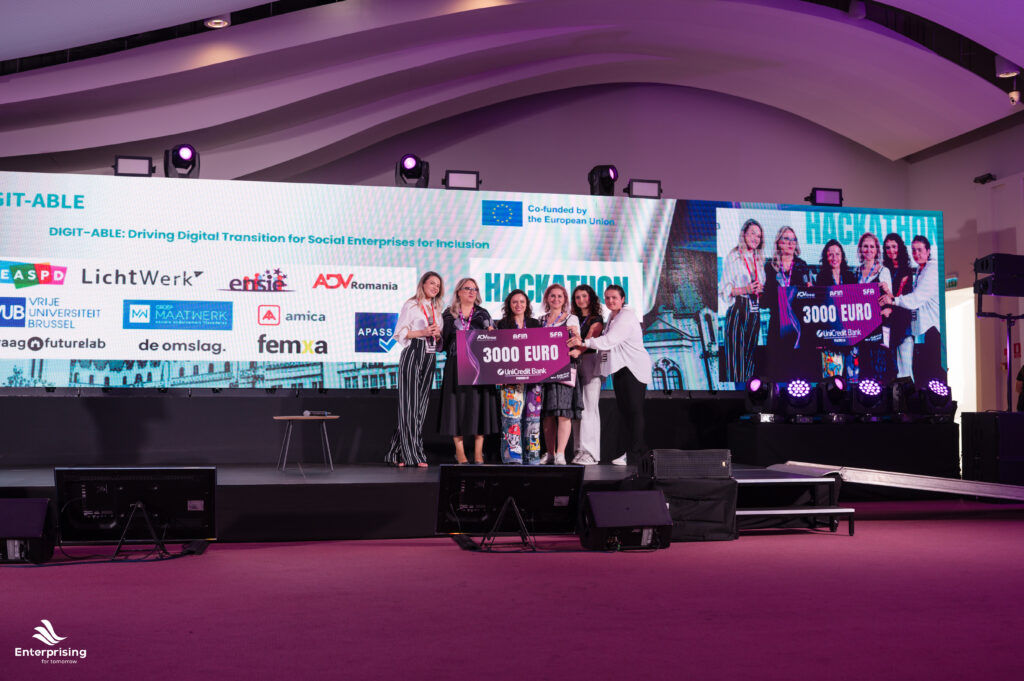
The team formed by the MMMAGIC, COROAMA and SOBE NELU social enterprises and Asociația Caritas Câmpulung received the award on 19 May during the Social Enterprise Accelerator Gala.
The prize provides the team with a resource for continuing and developing its idea. It also validates a collaborative process that brought together organisations with different experiences and areas of expertise.
For an idea developed during a hackathon to generate real results, an equally important stage follows: refining the solution, testing it with future users, identifying the necessary resources and establishing a model through which it can be implemented and sustained.
A competition can open this process. Long-term development depends on partnerships, expertise and access to funding.
19 May: What kind of digitalisation are we building?
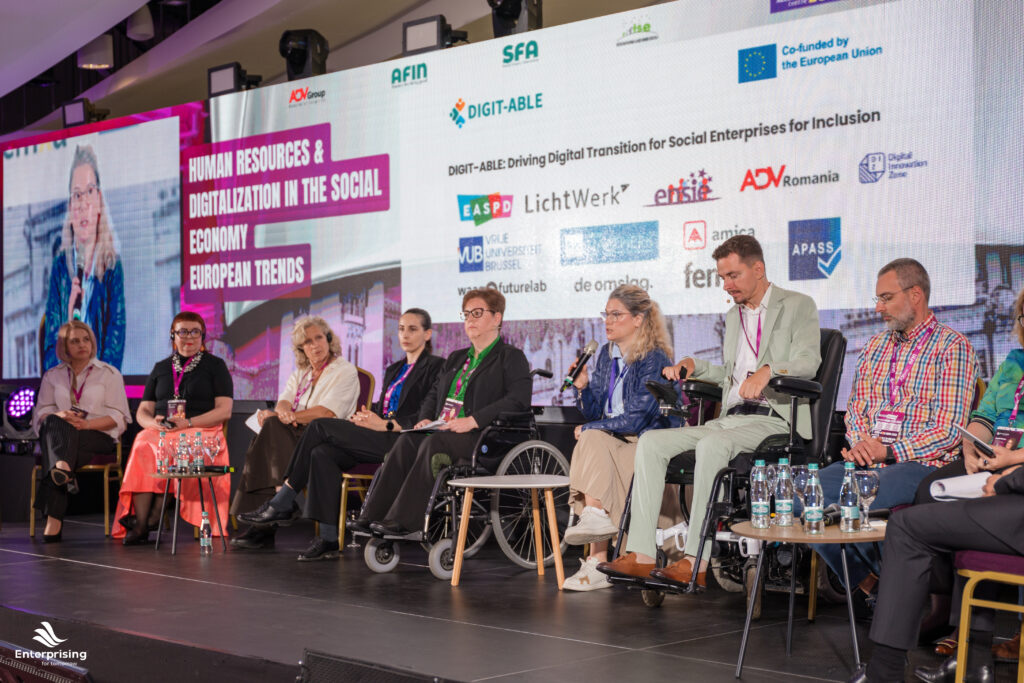
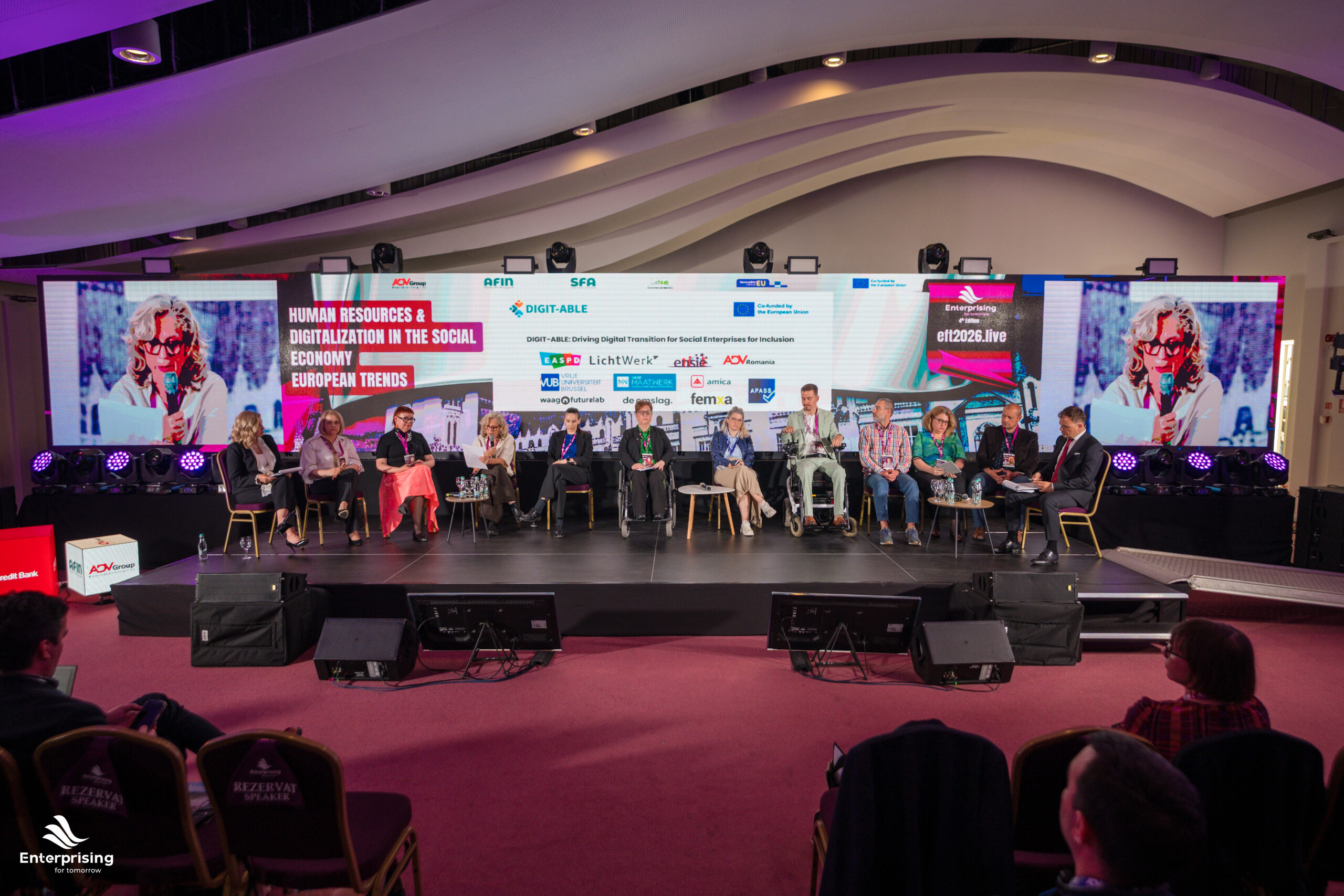
The second DIGIT-ABLE activity took place during Enterprising for Tomorrow 2026, the European conference organised by ADV Group.
The seminar on human resources development and digitalisation in the social economy brought together perspectives from European projects, research, technological innovation, social entrepreneurship and the disability sector.
One of the first conclusions was that access to technology and digital skills already influence a person’s ability to work, learn, use services and communicate with public institutions.
Digitalisation can reduce barriers, but it can also create new ones. An inaccessible platform, an online-only process or a tool developed without consulting its users can exclude the very people who need support the most.
Digital skills also involve the ability to assess technology
Corine van de Burgt, representative of the De Omslag Foundation and a member of the ENSIE Board, discussed the training programme developed through DIGIT-ABLE in the Netherlands.
Her message went beyond the technical use of digital tools:
“It is not only about learning how to use tools. We need to understand what technology does to people. If inclusion, access, privacy and democratic values are left out of the conversation, we can very easily deepen existing inequalities. Throughout the project, we focused on the kind of digital future we want: one in which technology is fair, open, inclusive and genuinely works for people and communities.”
Digital training should therefore not be limited to learning how to use applications.
Organisations must be able to assess costs, risks, the way data is used, the effects on employees and whether a technology is compatible with their social mission.
A technically efficient solution is not automatically the right solution for an organisation or the people it supports.
Digitalisation can increase the impact of a social enterprise
Cristina Baghiu, Hub Coordinator at Digital Innovation Zone, presented the cooperation with ADV Romania to develop a digitalisation hub dedicated to the social economy.
The hub is being built around the needs of actors in the sector and addresses areas such as training, digital accessibility and the difference between digitalising an existing process and using technology to innovate.
“Impact is valuable when it is sustainable and grows from one year to the next without requiring the same level of resources every time. Digitalisation is a powerful lever. It can bring beneficiaries closer and make communication and operational processes more efficient.”
For a social enterprise, technology can reduce the time spent on repetitive tasks, simplify data management, improve communication with beneficiaries and make it possible to deliver services to more people.
These benefits only emerge when the tool is selected according to the organisation’s needs and can be used by the people involved.
Digitalisation does not solve the absence of a clear process. In some situations, it may simply transfer an already difficult process onto a digital platform.
Inclusion requires contexts in which people can perform
Andrei Popa, founder of the Squeeze It authorised protected unit, brought forward the experience of a person with disabilities who built an enterprise in a competitive sector.
He discussed the realistic assessment of personal limitations, the identification of tools that can compensate for certain barriers and the adaptation of working methods.
“We operate in an extremely competitive field, marketing and creative services, where companies do not buy compassion. They buy results. I believe the most important lesson was that inclusion happens when we create contexts in which people can genuinely perform, not when we separate them into categories of vulnerable groups.”
Technology can help create these contexts.
Digital tools, remote work, assistive technologies and the automation of certain activities can reduce physical or communication barriers and increase a person’s autonomy.
During the same panel, Dan Patzelt, Director of APASS, emphasised that widely used technologies can become assistive when they are applied to address a limitation or facilitate access to work.
From this perspective, assistive technology should not be understood only as a separate category of specialised products. An everyday tool can sometimes serve an assistive function when it is accessible and used in a well-designed context.
20 May: From discussion to direct experience
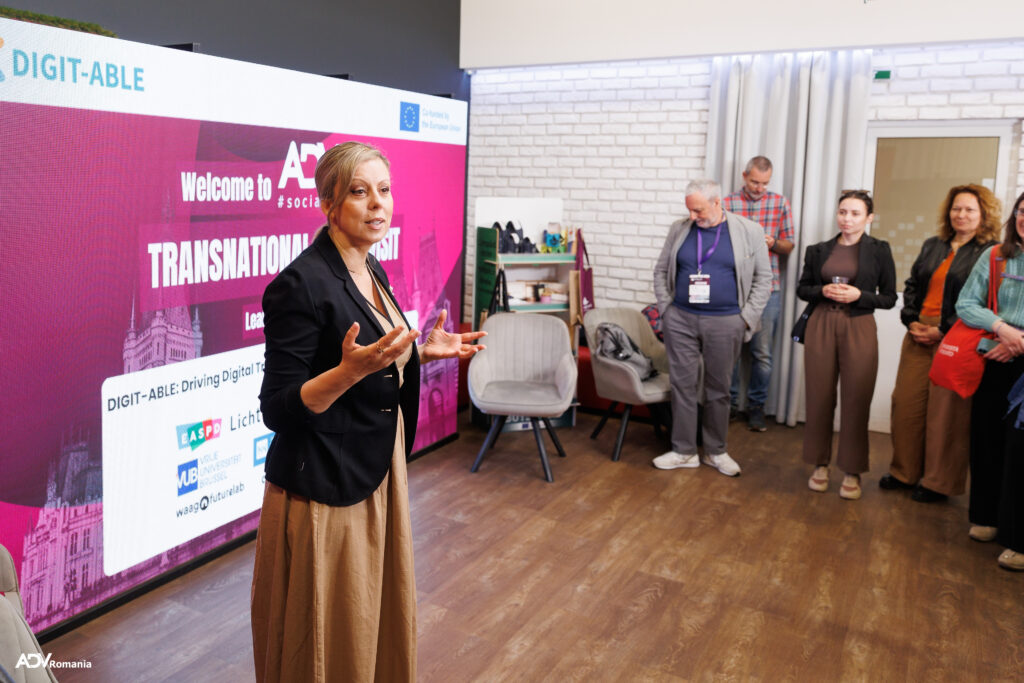
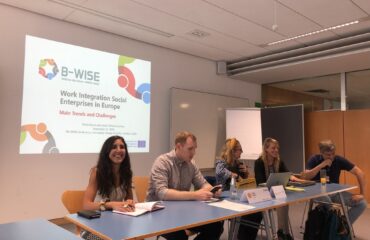
The transnational study visit complemented the hackathon and panel through a format based on observation, dialogue and the exchange of practices.
Participants examined how inclusion, employment, social entrepreneurship, training and digitalisation can be connected within an organisational ecosystem.
A study visit creates value when it goes beyond presenting results and allows participants to discuss the processes behind them: what resources are required, what difficulties have emerged, which solutions have been tested and what could be adapted to another context.
For ADV, the visit was an opportunity to share with partners the experience developed through working with persons with disabilities, building social enterprises, providing training and creating partnerships between organisations from different fields.
At the same time, it was a process of mutual learning. European partners brought their own methods, questions and experiences, contributing to a more nuanced understanding of digital transformation in the social economy.
Four principles for organisations beginning their digitalisation journey
The three-day experience offers several principles that can be applied beyond the DIGIT-ABLE project.
1. Define the problem before choosing the tool
Selecting a platform should not be the first step.
The organisation must understand which process needs to improve, who will use the solution and what specific change it wants to achieve. The hackathon began with the organisations’ challenges and only then explored possible digital responses.
2. Involve users from the beginning
The people who will use a solution must be consulted during its definition, testing and evaluation.
This principle is essential when the tool is intended for persons with disabilities or other groups that encounter barriers to access.
3. Accessibility is not a later correction
Adapting a platform after it has been completed is more difficult and more expensive.
Accessibility must be included in the initial requirements of the solution, alongside data protection, ease of use and compatibility with the organisation’s processes.
4. Digital transformation requires partnerships
Social organisations understand the challenges and the people affected by them. Technology specialists understand the possibilities and limitations of digital tools. Funders and companies can provide resources for testing and development.
A solution becomes applicable when these areas of expertise are connected and each partner understands the problem they are trying to solve.
ADV Group’s role in the digital transformation of the social economy
ADV Romania is not a technology provider. Its role is to connect experience from the field with the expertise and resources required to develop appropriate solutions.
Its direct experience in disability, employment and social entrepreneurship enables the organisation to identify challenges that are not always visible to the technology sector.
Through projects such as DIGIT-ABLE, these challenges can be transformed into training topics, experimentation processes and partnerships involving social organisations, digital experts, researchers, companies and funders.
The hackathon created a framework for developing solutions. The panel brought together European perspectives and direct experience. The study visit created opportunities for observation and the transfer of practices.
Together, the three activities point to a clear direction: the digitalisation of the social economy must begin with people, the barriers they encounter and the results organisations want to achieve.
Technology becomes relevant when it increases people’s autonomy, improves the quality of work and strengthens the capacity of organisations to respond more effectively to needs in their communities.