Română
How can support services become easier to understand, better connected and more useful for people seeking safety in a new country?
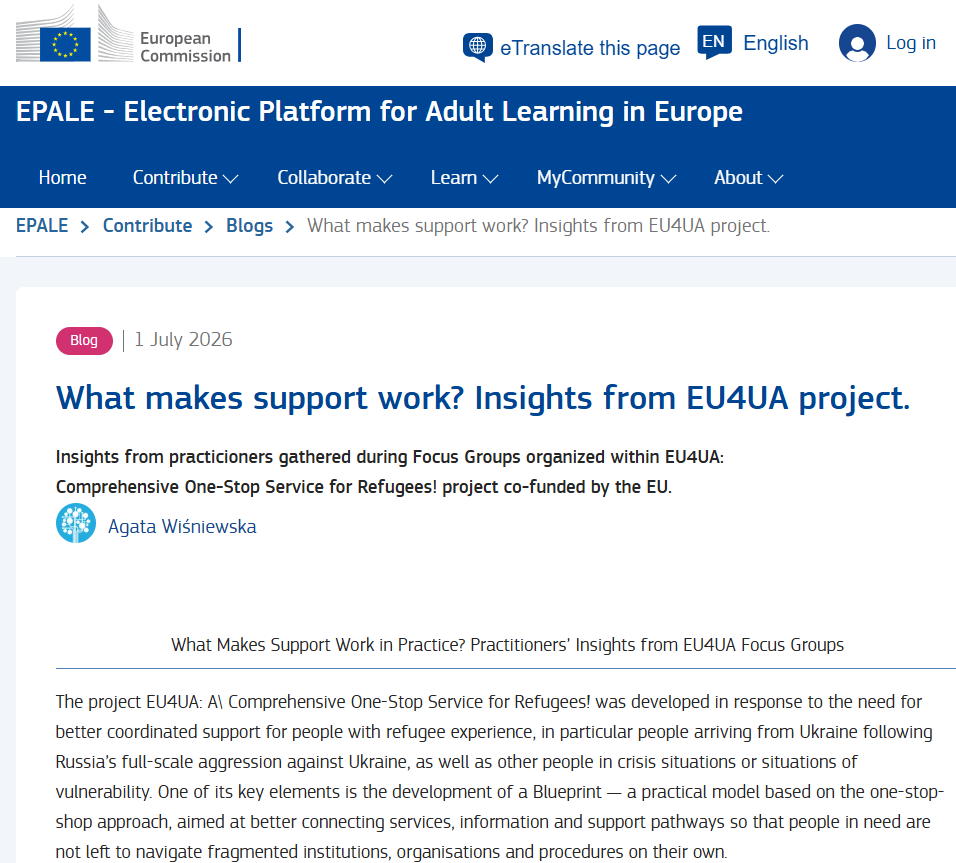
This question is at the heart of a new article published on EPALE, the Electronic Platform for Adult Learning in Europe, by Agata Wiśniewska, project coordinator at PCG Polska. The article presents insights gathered during EU4UA focus groups organised in Poland and Romania, as part of the project EU4UA: A Comprehensive One-Stop Service for Refugees!
As partner in the EU4UA consortium and lead of the work package dedicated to developing the Blueprint, ADV Group contributes its experience in social economy, inclusion, support services and stakeholder engagement to help shape a model that can be used by professionals, institutions and communities.
From real practice to a practical european model
The EU4UA project aims to develop, pilot and share an evidence-based Blueprint that supports the social and labour market integration of Ukrainian refugees in Poland, Romania and across Europe.
The focus groups organised in Romania and Poland helped the consortium better understand what practitioners need from such a tool.
Their message was clear: support must be easy to understand from the first contact, flexible enough to respond to different situations and coordinated across institutions, NGOs and other local actors.
The consultations highlighted four essential needs:
- clear guidance after registration or first contact with the system;
- simple procedures that can be used in crisis situations;
- flexible support pathways, adapted to people’s real needs;
- better coordination between public institutions, NGOs and community actors.
Why first contact matters
One of the strongest insights from the consultations was that first contact with the system should not remain a simple administrative step.
When a person receives a document, registers with an institution or asks for help for the first time, they also need a clear path forward.
They need to understand:
- what services are available;
- which steps come next;
- what documents are needed;
- who can offer guidance;
- how referrals work;
- what happens if a referral does not lead to support.
This finding is important for the EU4UA Blueprint because it shows that access depends on more than services. Access also depends on clarity.
For Ukrainian families seeking safety, a clear explanation can reduce confusion, save time and build trust. For frontline workers, clear procedures can make support more consistent and easier to provide under pressure.
Flexibility is not optional
The EPALE article also shows that support cannot follow one single path for everyone.
Some people can navigate information and services independently. Others need guidance, accompaniment, follow-up or longer-term case management.
A useful one-stop-shop model must recognise these differences.
This means that the Blueprint should help professionals decide:
- when basic information is enough;
- when a person needs guided referral;
- when follow-up is necessary;
- when longer-term support should be considered;
- how to adapt support without losing structure.
Coordination means building a support ecosystem
The one-stop-shop approach does not always mean bringing every service into one physical location.
The focus groups showed that what matters most is how actors work together. Public institutions, NGOs, social services, employment actors, health providers, community organisations and adult learning providers all contribute to the support journey.
Their work becomes stronger when roles are clear and referral pathways are reliable.
A coordinated ecosystem needs:
- clear responsibilities between actors;
- practical referral mechanisms;
- shared language and procedures;
- follow-up after referral;
- a clear role for case management;
- trust between public institutions and civil society organisations.
This is also where ADV Romania brings valuable experience from the field. Through its work in social economy, employment, inclusion and support for people facing barriers, ADV Group understands that systems work better when institutions, NGOs, social enterprises and communities act together.
Adv Romania’s role: transferring field knowledge into the blueprint
ADV Romania is proud to contribute to EU4UA and to work alongside partners from Poland, Romania, Lithuania, Spain and Belgium on a model that connects European cooperation with real community needs.
As lead partner for the development of the Blueprint, ADV Romania supports the process of turning research, consultations and practitioner feedback into a practical resource.
This role reflects ADV Group’s broader mission: to build solutions that connect social innovation with real impact in people’s lives.
Through EU4UA, ADV Romania helps transfer knowledge from the field into:
- practical guidance for professionals;
- clearer support pathways for people seeking safety;
- tools that can support coordination between institutions and NGOs;
- recommendations that can be adapted in different European contexts;
- a model that links social inclusion with labour market integration.
Communication is part of access
The article published on EPALE also highlights a point that is central to support work: communication is not secondary.
Language barriers, unclear procedures and different institutional terms can prevent people from accessing support, even when services exist.
For this reason, communication must be treated as part of the support pathway.
In practice, this means:
- using plain language;
- offering clear explanations;
- supporting translation and interpretation where needed;
- creating shared terminology between organisations;
- helping frontline workers explain next steps consistently;
- making information easier to understand for people in crisis.
This approach is closely connected to adult learning. When people arrive in a new country, they also learn how to understand institutions, ask for help, prepare documents, access employment pathways and rebuild independence.
Every clear explanation can become a step toward confidence.
A european conversation shaped by practitioners
By sharing EU4UA insights on EPALE, the project contributes to a wider European conversation on coordinated support, adult learning and social inclusion in crisis contexts.
The message from practitioners is clear: support works when people know where to start, when institutions coordinate and when communication helps people move forward.
For ADV Romania and ADV Group, EU4UA is an opportunity to contribute to this European learning process by bringing field experience, social innovation and a strong commitment to inclusion into the development of the Blueprint.
Read the full article on EPALE to discover how practitioners from Poland and Romania see the conditions that make support work in practice.
The project “EU4UA: A Comprehensive One-Stop Service for Refugees!” is implemented by PCG Polska (coordinator) in partnership with FISE, ADV Romania, Bethany Social Services Foundation, HumanDoc Foundation, Lietuvos socialinio verslo asociacija (LiSVA), FAEDEI, ENSIE and Diesis Network.
The project is funded by the European Union under the ESF+ Social Innovation+ (SI+) initiative. The views and opinions expressed are those of the authors and do not necessarily reflect those of the European Union or the European Social Fund Agency. Neither the European Union nor the granting authority can be held responsible for them.