Română
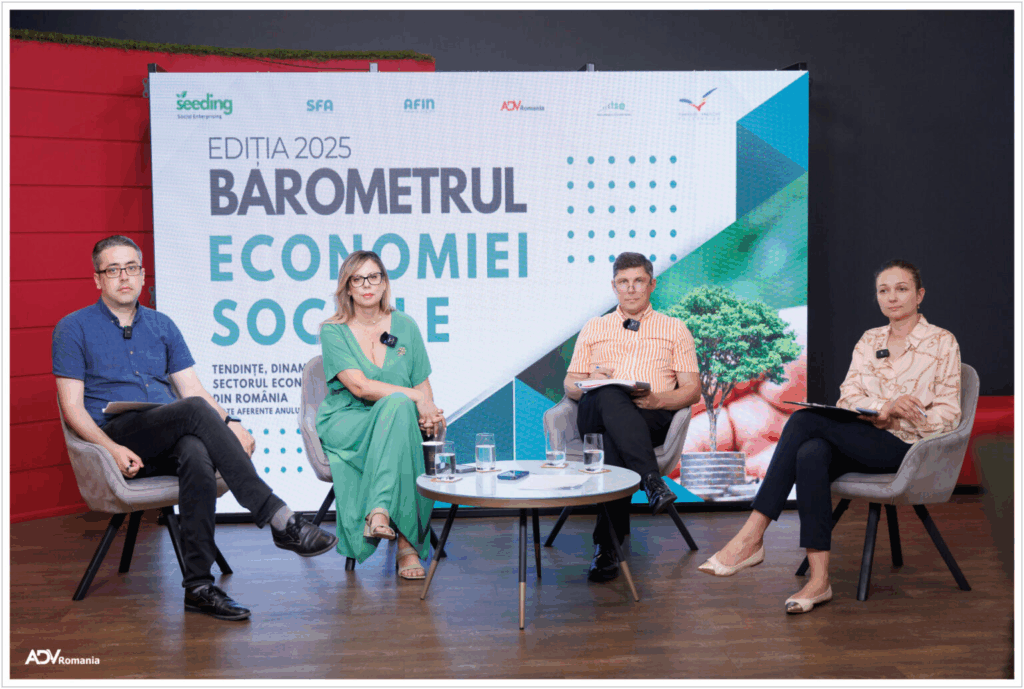
On 24 June 2025, ADV Romania Group, together with the Social Finance Association (SFA), AFIN IFN S.A. and RISE Romania, launched the fourth edition of the Barometer of the Social Economy. The report provides the most comprehensive analysis to date of Romania’s social economy sector, combining official statistics with a nationwide sociological survey. Its findings will inform the forthcoming National Strategy for the Social Economy 2025–2032.
The scale of the social economy sector
According to the Barometer, Romania counts 122,754 organizations with measurable social impact, representing 54% of all non-profit private administration entities. Between 2016 and 2024, 2,932 social enterprises were certified, but only 1,836 maintain active certification. Their economic contribution remains modest: approximately 4,036 jobs created and revenues of 96.5 million lei, equal to 0.03 percent of GDP.
Sheltered employment units play a visible role, yet the report highlights recurring integrity challenges. Cases of disproportionate turnover compared to the number of employees suggest misuse of fiscal benefits intended for integrating persons with disabilities.
Emerging opportunities
European funds remain the main driver of sector growth. Calls launched in 2024 under the Education and Employment Programme and the Inclusion and Social Dignity Programme (PoIDS) are expected to generate 5,809 new social enterprises and almost 30,000 jobs by 2025, with two-thirds allocated to vulnerable groups.
New financing lines planned for 2025 under the EU Just Transition Programme (PTJ), the Danube Delta Integrated Territorial Investment, and a blended credit–grant scheme managed by FNGCIMM will further expand support. By 2026, Romania could host over 6,500 active social enterprises.
A pressing social context
The report situates the sector against persistent socio-economic gaps:
- 27.9% of the population is at risk of poverty or social exclusion.
- 33.8% of children live in poverty (EU average: 24.2%).
- 19.3% of young people are NEET, with women disproportionately affected (24.8% – the highest rate in the EU).
- 16.8% of students leave school early, also the highest rate in the EU.
- Romania allocates only 12.8% of GDP to social protection, among the lowest levels in Europe.
These figures confirm the need for a more robust ecosystem where social enterprises can act as vehicles for inclusion, job creation, and local development.
“The social economy is the missing link between poverty reduction policies, labour market integration, and the green transition. With the right instruments, it can become a central driver of inclusion in Romania.” – Angela Achitei – President of ADV Romania Group
Policy implications
The Barometer underlines several priorities:
- Updating legislation and secondary regulations to reduce inconsistencies and increase incentives for work integration social enterprises.
- Expanding fiscal measures, such as income tax exemptions, and ensuring reserved public procurement quotas are applied.
- Diversifying financing instruments, from grants and loans to social investment funds and ethical banking.
- Building digital platforms for knowledge exchange, marketplaces, and impact reporting.
- Increasing transparency and accountability of sheltered units by linking fiscal benefits to the social enterprise certificate.
Looking ahead
The Ministry of Labour has confirmed that the Barometer’s findings will serve as a technical foundation for the National Strategy for the Social Economy 2025–2032. This strategy is expected to consolidate a fragmented policy environment into a coherent framework aligned with the European Action Plan for the Social Economy 2021–2030.